China is undeniably the world's most important manufacturing and engineering center for solar PV and battery energy storage systems (BESS). For overseas developers, distributors, investors, and EPC companies, sourcing from China provides unmatched access to competitive equipment, mature supply chains, and advanced integrated solutions.
However, many overseas buyers fall into the trap of being blinded by a low initial quotation. A cheap upfront price can quickly become an expensive nightmare if the contractor secretly switches key components right before shipment, delays delivery by months, or completely disappears when a critical grid-connection issue arises.
Selecting a reliable solar EPC contractor in China requires far more than comparing spreadsheets. This guide breaks down the exact evaluation process project owners must use to avoid common procurement disasters and secure a trustworthy partner for commercial, industrial, and utility-scale energy projects.
Phase 1: Background Due Diligence & Qualifications
1. Identify What the Company Actually Does
The term “solar EPC company” is used broadly, but not every supplier provides full engineering, procurement, and construction services. Before requesting a final quotation, you must uncover their true business model. A company may actually be:
•A trading company that merely purchases and exports equipment.
•A component manufacturer (solar modules, inverters, or batteries) pushing its own products.
•A system integrator responsible for equipment selection and commissioning.
•A complete EPC contractor responsible for design, procurement, construction, and acceptance.
For many international projects, the most practical and low-risk structure is partnering with a qualified Chinese PV and BESS solution provider who works alongside your experienced local installation team. Ensure the contract clearly delineates the responsibilities between the Chinese supplier and the local installer.
2. Verify Company Registration and Business Background
A polished website and generic factory photos are not proof of reliability. Buyers must conduct basic legal due diligence:
•Verify the legal company name, registration number, and registered business scope.
•Confirm whether the contract, invoice, and receiving bank account belong to the exact same entity.
•Check for abnormal business records or credit issues via China's National Enterprise Credit Information Publicity System.
Red flag: The supplier requests payment to a personal account, an offshore shell company, or an unrelated entity without providing a legally sound explanation.
3. Check EPC Qualifications and the Project Team
The required qualifications depend heavily on the project scope and destination country. Never simply accept a scanned, untranslated certificate.
•Verify that electrical engineers and project managers are registered and actively employed by the company.
•Confirm the company holds valid safety production permits.
•Understand that Chinese qualifications do not automatically replace the local construction licenses required in your destination country. A transparent contractor will openly explain where their legal responsibility ends and where a locally licensed partner must step in.
4. Verify Similar Project Experience
The best evidence of engineering capability is not a 3D rendering, but operational plants. Request at least three references similar to your proposed project. Look for matches in capacity, grid-connected/hybrid application, and climate conditions. Ask specifically what the contractor actually supplied—some companies claim a 50MW utility-scale plant as their case study when they only provided a fraction of the mounting structures. If possible, request commissioning records or performance data for projects that have been running for at least six to twelve months.
Phase 2: Technical Evaluation & Quality Control
5. Evaluate the Technical Proposal—Not Just the Price
A credible turnkey solar solution provider will demand comprehensive site data before ever promising system output or ROI.
For Solar Projects: They should analyze site shading, structural limitations, environmental corrosion risks, and specific n-type solar module degradation paths.
For BESS Projects: The proposal must detail cell chemistry, advanced liquid-cooled thermal management mechanics, PCS/BMS architecture, and fire protection systems.
Be highly suspicious of any supplier guaranteeing fixed energy yields or battery lifespans before receiving your complete grid-code and load profile data.
6. Lock the Bill of Materials (BOM) and Quality Standards
Vague contract descriptions like "equivalent brand" or "industry standard" are loopholes for component downgrades. Your contract’s technical annex must specify the exact approved Bill of Materials:
• Manufacturer, specific model number, and quantity.
• Battery cell brand, cell grade, and production batch traceability.
• Required international certifications and factory acceptance test (FAT) rules.
Any replacement of a key component must legally require the buyer’s written approval.
Phase 3: Financial Stability & Contractual Risk Mitigation
7. Assess Financial and Delivery Capability
Large energy projects fail just as often from bankruptcies as they do from engineering flaws. Your contractor must have robust cash flow and supply-chain leverage.
Assess their ability to provide performance and advance-payment bank guarantees. Payments must be strictly tied to measurable milestones (e.g., design approval, FAT completion, shipment, commissioning). Never pay a massive unsecured advance solely to lock in a "discounted" price.
8. Use an Ironclad EPC Contract
Verbal promises made during WeChat or WhatsApp negotiations are unenforceable. A reliable partnership requires a rigorous contract defining:
• Detailed scope of work, explicitly listing exclusions.
• Project schedule, payment milestones, and liquidated damages for delays.
• Energy yield, system efficiency, usable capacity, and availability guarantees.
• Applicable law and dispute resolution jurisdiction.
Phase 4: After-Sales Support & Warning Signs
9. Confirm Local After-Sales Support
A 10-year hardware warranty is useless if there is no practical way to execute a claim. Before signing with a BESS contractor or solar EPC, clarify the service protocol:
• Are there local engineers or authorized service partners in your region?
• Who pays for labor, international shipping, and replacement parts during a warranty claim?
• Can the original manufacturer’s warranty be transferred directly to the project owner if the EPC goes out of business?
10. Watch for Common Warning Signs
Immediately pause negotiations if a potential contractor:
• Offers a price 20% below the market average.
• Refuses independent third-party factory audits (like SGS or TÜV) or pre-shipment inspections.
• Avoids naming subcontractors.
• Uses entirely different company names for contracting, invoicing, and receiving funds.
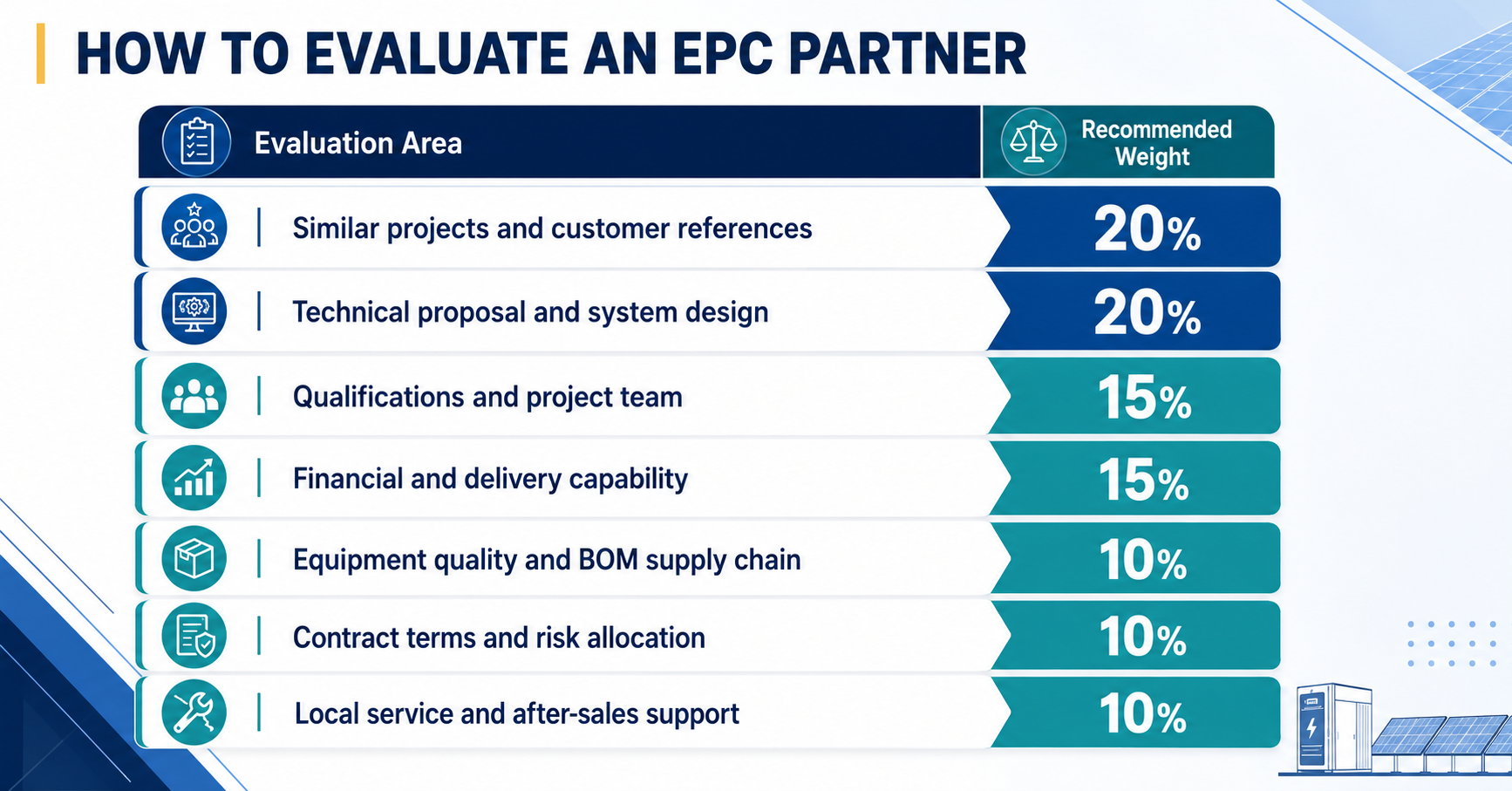
A Practical Contractor Evaluation Scorecard
Use a weighted evaluation matrix instead of automatically selecting the lowest bidder. A technically compliant, financially stable contractor always presents a lower total lifecycle cost.
Final Checklist Before Signing
Before appointing a solar EPC contractor in China, confirm you have:
• Verified the legal company and receiving bank account.
• Visited or independently audited the factory.
• Approved a highly detailed Bill of Materials (BOM).
• Linked payments to measurable performance milestones.
• Confirmed exact local installation and after-sales responsibilities.
Frequently Asked Questions
Is the lowest-priced solar EPC contractor the best choice?
Usually not. Bottom-tier quotations often hide downgraded equipment brands, reduced construction scopes, and weak warranty terms. Always evaluate total lifecycle risk, not just the initial capital expenditure.
How can I verify whether a Chinese solar company is a real manufacturer?
Check legal registrations, confirm the physical factory address, conduct a live video inspection, or hire a third-party auditor. Ensure the company name matches across their business licenses, test reports, and bank accounts.
Should I use a Chinese EPC contractor or a local installer?
A hybrid model is often the most successful for international projects. A Chinese solar and energy storage integrator provides the system engineering, top-tier equipment procurement, and remote technical support, while a licensed local contractor manages the physical site construction, civil works, and grid compliance.
Choose a Partner Based on Evidence, Not Promises
Trust in a utility-scale renewable energy project must be built on verifiable data: traceable supply chains, robust engineering, and enforceable contracts.
Navigating cross-border procurement requires a partner with a proven global track record. With an annual commercial delivery footprint exceeding $120 million, SunEvo provides unparalleled support in project evaluation, B2B system configuration, high-end equipment integration, and coordinated delivery.
Whether you are configuring n-type module arrays or industrial liquid-cooled energy storage cabinets, share your project location, load profile, and required capacity with our team to receive a deeply customized, risk-free technical proposal.
Contact SunEvo for a customized solar PV and BESS solution.
Recommended Internal Links
One-Stop Solar PV and BESS Solutions
Commercial and Industrial Energy Storage Systems



 Obsługiwana sieć IPv6

 English
 français
 Deutsch
 italiano
 español
 português
 العربية
 日本語
日本語 ไทย
ไทย