Air Cooling vs Liquid Cooling for C&I Energy Storage: Which Thermal Management Is Right for Your Project
Compare air-cooled and liquid-cooled C&I battery energy storage systems on temperature uniformity, CAPEX, O&M, footprint, and real-world scenarios to make the correct BESS selection.
Key Takeaways
Thermal management directly determines C&I BESS safety, battery cycle life, auxiliary power consumption, and total-cost-of-ownership (TCO). Neither air cooling nor liquid cooling is universally superior.
Air-cooled C&I ESS: Lower upfront cost, simple maintenance; best for small-medium capacity, mild climate, low-moderate cycling duty cycle
Liquid-cooled C&I ESS: Superior cell temperature uniformity, higher power density, strong environmental adaptability; ideal for large-scale, high-rate, frequent cycling or harsh climate projects.
How Air Cooling and Liquid Cooling Work for C&I BESS
Air-Cooled System
Air cooling uses fans and HVAC units to circulate air across battery module surfaces to dissipate heat. Core components include fans, filters, air ducts and air-conditioning units. No liquid circulation loop is required, with a simple mechanical structure and low engineering barrier.
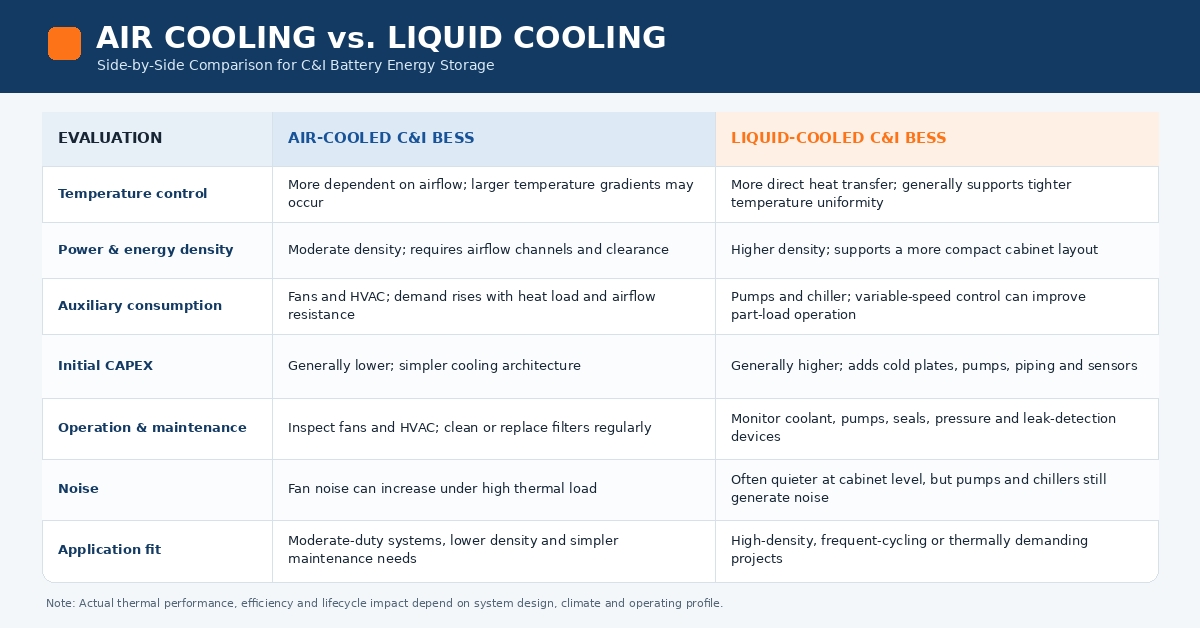
Under high load or high ambient temperature, air’s low thermal conductivity leads to uneven heat dissipation. Cell-to-cell temperature difference normally reaches 8 15℃, creating local hot spots that accelerate inconsistent battery degradation.
Liquid-Cooled System
Liquid-cooled BESS adopts closed-loop glycol-water coolant circulating through cold plates tightly attached to battery modules. Heat is transferred to external heat exchangers and released to the ambient environment.
Well-designed liquid cooling restricts cell-to-cell temperature delta within 2-3℃. A stable, uniform thermal field keeps lithium-ion cells operating inside the optimal 20-30 °C working window, slowing calendar- and cycle-based ageing significantly.
Side by Side Technical & Economic Comparison
When to Choose Air-Cooled C&I Storage
Select air cooling if your project matches most of the criteria below:
1. Small to medium capacity, generally ≤3 MWh; peak shaving, backup power with light to moderate cycling (once daily charge-discharge).
2. Mild ambient climate, no long term extreme high-temperature above 38-40 °C; clean air with low dust and salt mist.
3. Budget-sensitive CAPEX, limited local on-site maintenance resources.
4. Sufficient installation space to reserve airflow clearance for cabinets or containers.
Typical use cases: small manufacturing workshops, commercial building backup power, small PV storage self-consumption projects.
When to Choose Liquid-Cooled C&I Storage
Liquid cooling delivers better long-term return-on-investment for these conditions:
1. Large-capacity containerized C&I BESS ≥3 MWh, frequent daily cycling such as two charge, two discharge for demand response or arbitrage with large peak valley tariff gap.
2. Harsh operating environment: persistent high-temperature, industrial heavy dust, coastal salt fog areas.
3. Limited land space; need high-density integrated cabinets to maximise site utilisation.
4. Noise-sensitive locations, or projects targeting full-lifecycle revenue and minimised battery premature replacement risk.
Typical use cases: industrial parks, microgrids, heavy-demand-charge management, large PV-storage facilities.
Common Pitfalls in Thermal-Management Selection
1. Only compare initial price: Air cooling saves upfront money, yet uneven thermal distribution may cause partial cell degradation, lowering usable capacity and shortening project revenue cycle. Evaluate full-lifecycle TCO instead of CAPEX alone.
2. Over-expect air-cooled performance under extreme heat: When ambient temperature keeps rising, air-cooled systems increase fan speed and auxiliary consumption; BMS may trigger power derating to avoid overheating, hurting actual economic output.
3. Neglect liquid-cooled system quality risk: Poor pipeline sealing and missing leak detection create safety hazards. Always require complete leak monitoring, mature coolant formula, and qualified after-sales service capability for liquid-cooled units.
FAQ
Q1: Is liquid-cooled C&I storage always better?
A: No. Liquid cooling brings higher CAPEX and more complex fluid loop maintenance. Air-cooled solutions remain cost-effective for mild-climate, small-scale, low-cycling C&I scenarios.
Q2: How much difference does cell-to-cell temperature delta make?
A: Large temperature difference creates “weak-cell effect”. The weakest cell determines the whole-pack usable capacity. Sustained hot-spots shorten practical battery life significantly, even if single-cell specification remains unchanged.
Q3: Can air-cooled BESS work in hot regions?
A: It can operate, but expect higher auxiliary energy loss, accelerated ageing risk, and possible power derating during summer heat peaks. Do thermal simulation before final selection.
Conclusion
Air cooling and liquid cooling represent two proven, mature thermal management pathways for commercial industrial battery storage. Prioritise air-cooled C&I ESS for small medium projects in mild climates with cost priority and moderate operating intensity. Choose liquid-cooled C&I ESS for large scale, high cycling, high density or harsh environment projects, where higher upfront cost is offset by longer battery service life, higher available capacity and lower long term failure risk.
Always combine project capacity, local climate, daily charge-discharge profile, available footprint, maintenance capacity and TCO calculation to finalise your cooling architecture decision.



 Obsługiwana sieć IPv6

 English
 français
 Deutsch
 italiano
 español
 português
 العربية
 日本語
日本語 ไทย
ไทย